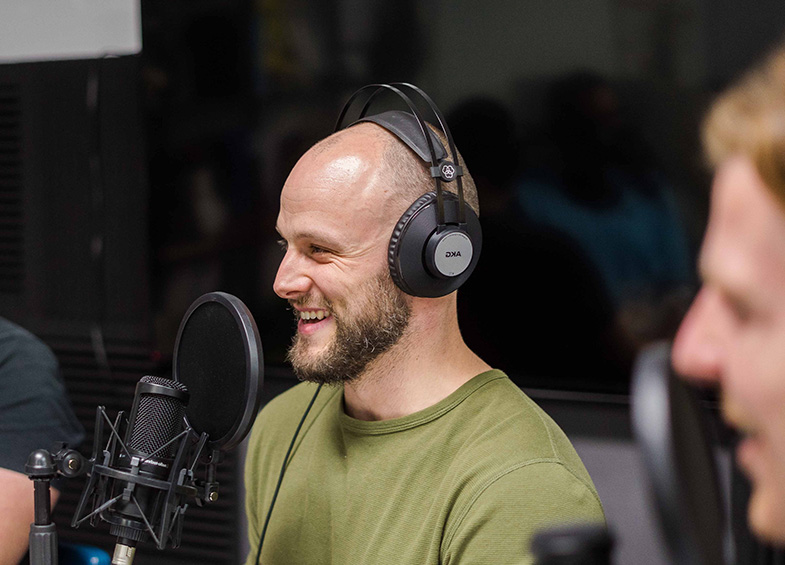
Becoming a father can change more than your schedule. It can change what work means, what money represents, and how you measure whether you are doing enough.
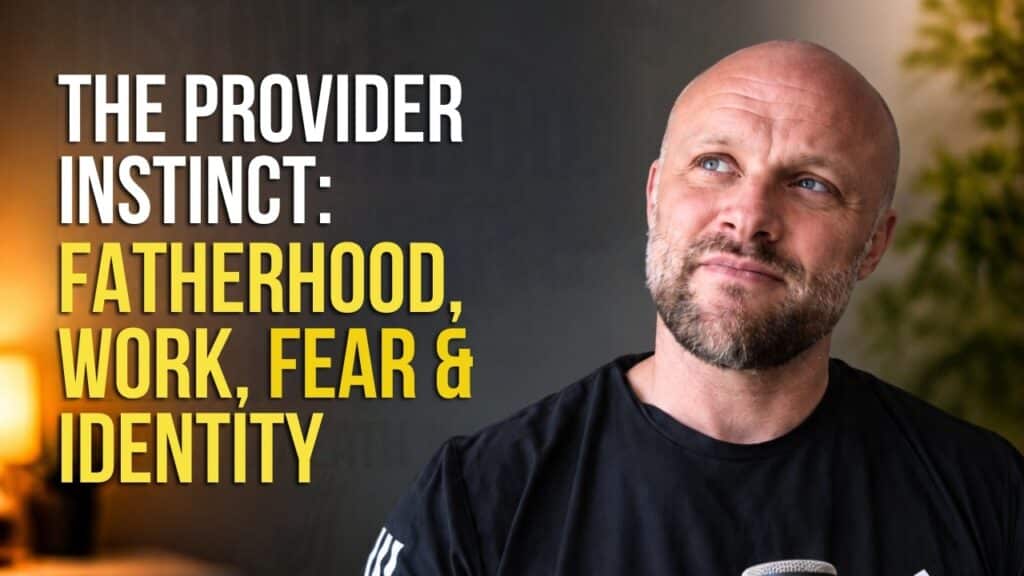
In Beyond Breath Episode 4, Martin McPhilimey examines what he calls the provider instinct: the drive to create safety and opportunity for a family, and the way that drive can gradually become fused with ambition, fear and identity.
This is not an argument that men possess a single biological “provider circuit”. It is a more careful question: could the pressure to provide emerge from several emotional and motivational systems working together—and what happens when one of those systems begins to dominate?
Watch or listen to the full episode:
Watch on YouTube
Listen on Spotify
Key takeaways
- The “provider instinct” is best understood as a useful description of experience, not a proven single instinct or male-specific brain circuit.
- Care can give work a deeper purpose, while fear can quietly turn responsibility into overwork and self-worth into a revenue target.
- Good intentions do not automatically create an equal family system; caregiving, career opportunity and mental load still need to be discussed openly.
- Breathwork may help create conditions for noticing emotion and bodily signals, but it does not prove that one interpretation is objectively true.
- Providing can include money and security without being reduced to them. Attention, time, play, emotional availability and support also matter.
Is there really a male provider instinct?
The phrase “provider instinct” feels intuitively familiar. Many fathers describe a sharp increase in responsibility after the birth of a child: a stronger urge to protect, earn, plan and create stability.
But an experience can be real without mapping neatly onto one biological mechanism. In the episode, Martin uses Jaak Panksepp’s affective neuroscience as a framework for thinking about this complexity. Panksepp proposed several primary-process emotional systems in mammalian brains, including CARE, SEEKING, FEAR and PLAY. His cross-species work is influential, but applying it to modern family roles is an interpretation rather than proof of a dedicated provider instinct.
A more nuanced possibility is that provider behaviour can arise from a blend:
- CARE supports nurturing, protection and responsibility.
- SEEKING supports pursuit, exploration, goal-directed effort and resource acquisition.
- FEAR scans for threats and possible losses.
- PLAY supports flexibility, experimentation, social connection and creativity.
The central question is therefore not simply, “Do men have a provider instinct?” It is, “Which systems are shaping this person’s way of providing, and are they still serving the family well?”
For readers who want the scientific background, see Panksepp’s open-access paper on cross-species affective neuroscience.
How fatherhood can change the meaning of work
Before parenthood, work may represent independence, mastery, status, service or personal ambition. After a child arrives, the same work can begin to carry a different emotional weight. Income becomes housing, healthcare, education, freedom, protection and future opportunity.
In Martin’s story, fatherhood did not simply make him want more money. It changed the meaning attached to money. Growing a business began to feel like evidence that he was creating a secure life for his family.
This can be deeply motivating. CARE gives the effort purpose, while SEEKING supplies energy for building, solving problems and pursuing opportunities. The difficulty begins when the goal is no longer only to support the family, but also to quiet the internal fear of failing them.
When useful pressure becomes expensive
Stress is not always the enemy. A degree of pressure can sharpen attention, increase effort and help a new parent respond to real demands. The problem is that a short-term adaptation can become a long-term operating system.
Martin describes a period of seeing 35 to 40 clients while delivering around 30 hours of live teaching a week. The workload looked productive from the outside, but the body was giving different information: fatigue, unplanned naps, weight loss and concerning blood markers.
That distinction matters. High output is not the same as sustainable performance, and devotion to family does not make the physiological cost of chronic overload disappear.
The response was not to abandon ambition. It was to redesign delivery. Moving more teaching into groups allowed the work to reach more people without relying on endless one-to-one hours. This is an important form of providing too: building systems that preserve the person doing the work.
When providing becomes an identity
A role becomes risky when it turns into a verdict on who you are.
If revenue starts to mean “I am a good father,” then any reduction in work can feel like more than a practical choice. It can feel like a threat to identity. Rest, caregiving or supporting a partner’s career may register internally as loss of control, even when those choices are aligned with the family’s broader needs.
This is where ambition and fear can look remarkably similar. Both can produce long hours, constant planning and a drive to grow. The difference is often visible in flexibility: can you slow down, share responsibility or change direction without feeling that your worth is collapsing?
Questions worth asking
- What does income mean to me beyond the number itself?
- What am I afraid would happen if I worked less for a period?
- Has “providing” become part of how I prove my value?
- Am I building security, or repeatedly trying to eliminate an anxiety that has no finish line?
Good intentions can still create unequal family roles
One of the most honest parts of the episode concerns Martin’s wife wanting to return to her own perfumery business. Her renewed career focus implied a shift in caregiving: more time with their daughter for Martin, fewer hours available for his work, and potentially less revenue.
The first reaction was fear.
That does not make the desire to provide false or selfish. It does reveal how a family system can become unequal without either partner explicitly choosing inequality. One person’s paid work can be treated as fixed and essential, while the other person’s career, time and ambitions remain flexible. The invisible cost is then carried by the partner whose opportunities are repeatedly deferred.
Providing for a family therefore requires more than intention. It requires ongoing negotiation about time, money, caregiving, mental load and whose ambitions receive practical support.
What breathwork can—and cannot—reveal
During a conscious connected breathing session, Martin noticed fear beneath the resistance he had been feeling. The experience did not function as a diagnostic test or establish a scientific fact. It created a setting in which bodily sensations, emotion and meaning became easier to observe.
That distinction is important. Breathwork can support attention to internal experience, but the story we attach to that experience still deserves reflection, conversation and, where appropriate, professional support. Insight is most useful when it opens inquiry rather than ending it.
This is one reason the School of Breath Science approaches breathing through physiology, psychology and context rather than treating every intense experience as proof. Learn more about respiratory interoception and the role of internal bodily signals.
Bringing PLAY back into work and fatherhood
The alternative to fear-driven work is not passivity. It may be a different quality of motivation.
Martin’s reflection was to let PLAY have a larger role: experimenting, following curiosity, building with more flexibility and allowing work to contain discovery rather than only pressure. That shift does not remove deadlines or financial responsibility. It changes the emotional system doing most of the steering.
PLAY also belongs at home. For a child, a present father is not only a source of resources. He is someone available for attention, delight, repair, creativity and connection.
In that sense, the provider role can expand rather than disappear.
A broader definition of providing
Money matters. Stability matters. Planning matters. The problem is not financial provision; it is reducing provision to a single metric.
A broader definition may include:
- creating financial and practical security;
- being emotionally available during stress;
- protecting time for connection and play;
- sharing caregiving and domestic responsibility;
- supporting a partner’s ambitions as seriously as your own;
- modelling sustainable effort, reflection and repair; and
- being present enough to know what the family actually needs.
The provider instinct becomes healthier when it remains a role you can examine, rather than an identity you must defend.
A five-minute provider check-in
- Name the threat: Write down what you fear would happen if you reduced your workload for one month.
- Separate facts from identity: Which consequences are practical, and which sound like a judgment about your worth?
- Check the family system: Ask whose time, career or recovery currently absorbs the cost of your work pattern.
- Expand the definition: Choose one non-financial way of providing this week—presence, play, caregiving, support or protected time.
- Test, then review: Make one small change and notice what happens in your body, relationships and work before drawing a conclusion.
This is a reflection exercise, not a clinical assessment. If work pressure, anxiety or exhaustion is significantly affecting your health or relationships, consider seeking appropriate professional support.
Listen to Beyond Breath Episode 4
This episode is a personal exploration, not a final answer about biology or gender. It offers a useful invitation: notice what sits beneath the drive to work, grow and protect. Is it care, curiosity, fear, play—or some changing combination of all four?
Watch “The Provider Instinct: Fatherhood, Work, Fear & Identity” on YouTube
Listen to the episode on Spotify
If you want to study the interaction between breathing, interoception, affective neuroscience and behaviour in greater depth, explore the School of Breath Science courses.