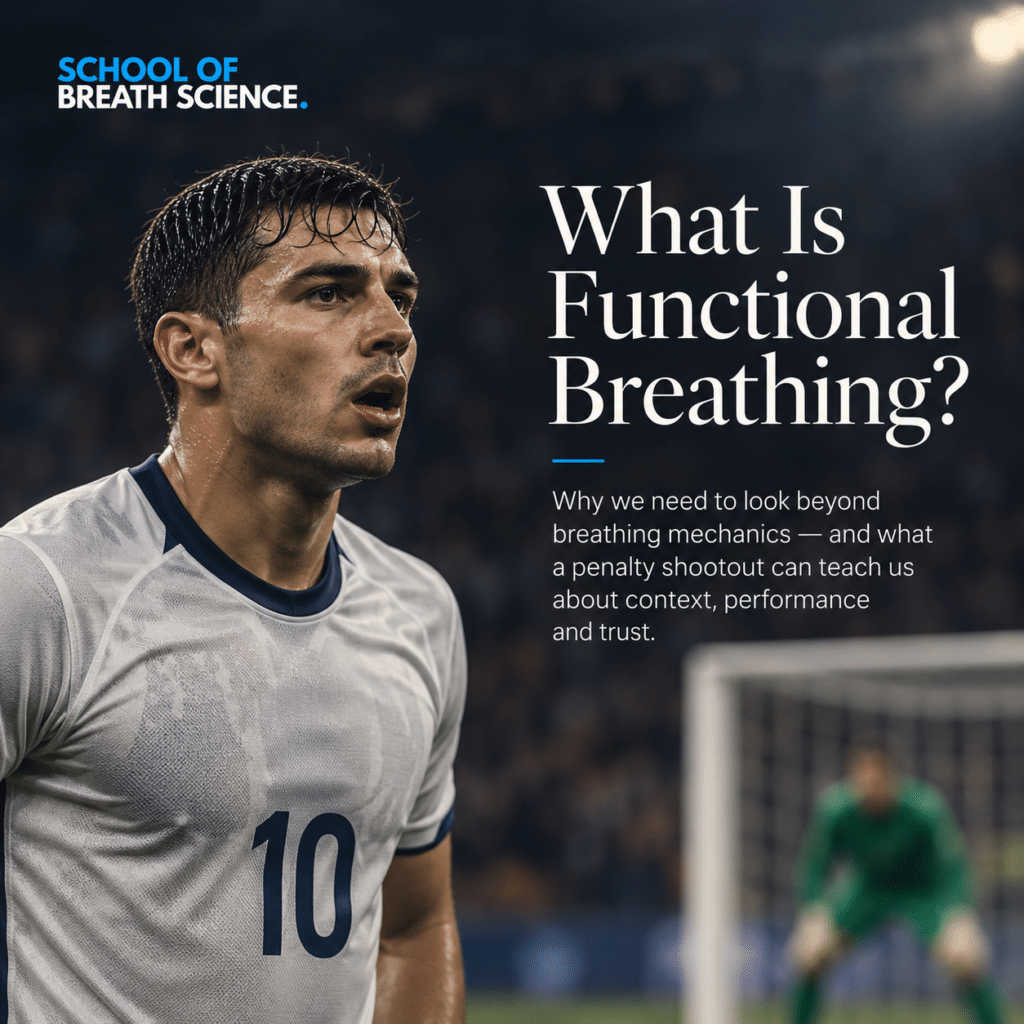
During the FIFA World Cup this year, I was scrolling through LinkedIn when I came across a post from someone working as a functional breathing coach. They were commenting on some of the footballers preparing to take penalties during a shootout.
The observation was that some of the players had their mouths open, there were large movements around the upper airway, and their respiratory rates appeared relatively high. The suggestion was that if these players could instead breathe low, slow and deep, they might become calmer and more focused and therefore have a better chance of scoring.
It got me thinking.
If we’re calling this dysfunctional breathing from appearance alone, are we actually assessing the athlete, or are we imposing our preferred breathing pattern, and perhaps even our preferred state, onto them?
I think this points towards a much bigger issue within the functional breathing and functional breathwork space. We have become pretty good at observing what someone’s breathing looks like. I’m not convinced we’ve become equally good at asking what that breathing is actually doing for the person.
From Clinical Dysfunctional Breathing to Functional Breathwork
Much of the evidence base and education that has influenced the modern functional breathing space, outside of the clinical world itself, has come through training systems such as Buteyko and Oxygen Advantage. These approaches have drawn on evidence and concepts from the dysfunctional breathing literature, breathing retraining and their own methodology.
There is useful information within this. Some of it good, some of it misses the mark. So I don’t think we should throw those ideas away. The question is whether concepts developed or investigated in one context can simply be transferred into another without considering the population and the task.
A lot of the dysfunctional breathing literature has historically been viewed through a clinical lens and there is still a lot more disagreement amount terms and assessing. We may be dealing with people presenting with breathlessness, asthma, COPD, impaired lung function or other symptoms and respiratory limitations. That is very different from observing an athlete in a performance environment.
There has also been research looking at athletes from a mechanical standpoint and reporting very high rates (90%) of supposed dysfunctional breathing. Again, I think we have to be careful about what exactly is being measured and what conclusions we then draw from it. If we take criteria or assumptions derived from clinical investigation and drop them directly into a performance setting, we risk comparing two very different contexts as though they are the same thing.
This is where I think we have started to confuse the form of someone’s breathing with the function it is providing.
Nasal breathing equals good. Mouth breathing equals bad. Diaphragmatic breathing equals good. Chest breathing equals bad. Slow breathing equals good. Fast breathing equals bad. Higher CO₂ equals good. Lower CO₂ equals bad.
The problem isn’t necessarily with observing any of those things. The problem is when those observations become conclusions after the context has been removed.
Breathing mechanics are a data point. They are not, by themselves, a diagnosis.
The same breathing pattern can be adaptive in one context and limiting in another. We have to consider the person, the task, the environment, the objective and the constraints before deciding what a breathing pattern means.
What Is the Correct Breathing Pattern?
Think about this for a moment.
What breathing pattern is correct in a quiet, low-demand environment? Perhaps gentle nasal breathing is entirely appropriate.
What happens when that person starts walking and metabolic and postural demands change? What happens when they are playing an intermittent high-intensity sport requiring skill, communication and rapid decision-making?
Should they still be breathing nasally, diaphragmatically, low and slow?
What about maximal sprinting or another high-performance situation requiring very high levels of ventilation and mechanical output?
How you breathe when you rest, move or sleep changes because breathing is responsive to physiological demand and its expression is highly state- and context-dependent.
The question of which breathing pattern is “correct” becomes incomplete when we remove the context.
This brings me back to the footballer preparing to take a penalty. How is that person actually relating to their breathing in that moment? What is happening within the context of that moment, and how much can we really infer simply by watching them?
We could observe respiratory rate. If it’s high, we might reasonably hypothesise that there is increased physiological arousal. But does increased arousal automatically mean something negative?
That depends on what the person needs to do.
If an athlete has a high success rate taking penalties while breathing and experiencing arousal in a particular way, attempting to manipulate that immediately before performance may not improve anything. We might actually introduce a new constraint by asking them to internally monitor and alter a state that has previously supported successful performance.
There is also the issue of state-dependent performance and learning. The state we think looks calm from the outside may not be the state that allows that particular athlete to execute the skill most effectively.
This is why I think we need to be much more cautious about taking a clinical perspective and imposing it directly onto a performance setting.
A Different Framework for Functional Breathing
As part of the School of Breath Science’s wider mission to raise standards in breath education, I’m developing a framework around five questions:
Functional: Does it serve the situation?
Effective: Does it achieve the outcome?
Efficient: At what cost?
Optimal: What is best for this particular objective?
Dysfunctional: Is it creating a limitation?
These terms are often treated as though they mean roughly the same thing. I don’t think they do.
1. Functional Breathing: Does It Serve the Situation?
For me, functional breathing is adaptive, responsive and appropriate to the individual’s goals, context and constraints. It is also supported by a trusting relationship with the body’s ability to regulate breathing automatically, while remaining available for conscious influence when useful.
The important ideas here are adaptability, autonomy, context, trust, flexibility and a proportionate response to the situation.
I think one of the biggest variables missing from much of the functional breathing conversation is this:
What relationship does the person have with their breathing?
I think this matters in both clinical and performance environments.
We spend a lot of time teaching people how to control their breathing and how to correct their breathing. I wonder whether, in some circumstances, we’ve also inadvertently taught people to distrust it.
When Breathing Education Creates Mistrust
This came up recently during one of our case study discussions inside the School of Breath Science professional community. One of our practitioners brought a case involving a client who described herself, in her own words, as a recovering “apical breather.”
What was interesting was that every time she tried to engage in a breathing practice, she struggled. There wasn’t enough regulation available because engaging with the breath itself produced a level of activation she didn’t like, which then contributed to avoidance.
She was a movement practitioner herself. From the outside, you might look at her and decide that she appeared to breathe well. But mechanically “good-looking” breathing wasn’t really the central issue.
There appeared to be a deeper belief around how she thought she should breathe. Ideas and labels she had picked up through training, books and information online had contributed to a mistrust of her own breathing. Instead of breathing being something adaptable and largely autonomous, it had become something that needed to be monitored and corrected.
That’s not a particularly functional relationship with breathing.
Trust doesn’t mean never intervening. It doesn’t mean we should never deliberately change our breathing.
It means being able to consciously influence breathing when there is a useful reason to do so, while also being able to relinquish that control and allow breathing to return to autonomous regulation.
Which Person Has the More Functional Breathing?
Consider two people.
Person A is 90 minutes into a football match. They’re mouth breathing, showing large thoracic movements and have a high respiratory rate. They’re not monitoring their breathing. There’s no fear around it, no obvious breathing-related limitation, and their attention remains on tactics, skills and teammates.
Person B is sitting quietly. They’re breathing nasally and slowly, with visible diaphragmatic movement. But they’re constantly monitoring their breathing to make sure it’s okay. They become anxious when the pattern changes and feel responsible for consciously controlling every breath.
Which person has the more functional breathing?
More importantly, which person has the more functional relationship with their breathing?
The form of the breathing pattern alone cannot answer those questions.
2. Effective Breathing: Did It Achieve the Required Outcome?
Effective breathing is about whether the breathing helps achieve the intended outcome.
For the footballer, the objective isn’t to maintain a particular breathing pattern. The objective is to maintain work rate, execute skills, communicate, scan the field, make decisions and tolerate fatigue.
If the athlete is achieving those outcomes, we shouldn’t automatically assume that their breathing needs changing simply because it doesn’t match our preferred pattern.
Automaticity may actually contribute to effectiveness. If the athlete doesn’t have to consciously think about breathing, their attention remains available for the task itself rather than competing with internal monitoring.
That doesn’t mean there isn’t a cost, which brings us to efficiency.
3. Efficient Breathing: At What Cost?
There is always some cost associated with breathing.
There is the physiological cost of the work of breathing, respiratory muscle demand, ventilation and recovery. There can also be cognitive costs associated with attention, monitoring, decision-making and perceived effort, alongside energetic considerations such as sustainability, economy and unnecessary muscular work.
So efficient breathing doesn’t mean low, slow and deep.
It means that the cost is proportionate to the required outcome.
This is also where the relevance of breathing training may differ between sports. In a lower-skill, longer-duration event such as distance running, improvements in ventilatory economy, respiratory muscle function or pacing may have particular relevance because sustainability is central to performance.
In a highly skilled intermittent sport such as football, however, breathing is occurring alongside constant perceptual, cognitive, tactical and motor demands. The breathing strategy cannot be considered separately from those demands.
4. Optimal Breathing: Optimal for What?
This moves us into the idea of optimal breathing.
Whenever somebody says a particular way of breathing is “optimal”, my next question is:
Optimal for what?
Recovery? Regulation? Endurance? Sprinting? Sleep? Strength? Emotional state? Performance?
Optimal breathing is objective-dependent and constraint-dependent. It isn’t a universal breathing pattern.
During recovery, perhaps we’re interested in down-regulation, comfort and allowing physiology to move back towards baseline. We might play with breathing rhythms and allow the person to explore what helps them feel more settled without forcing them into a prescribed pattern.
For regulation, we may deliberately use breathing to shift state and attention and potentially create greater behavioural flexibility.
For an endurance runner, optimal breathing might place greater emphasis on ventilatory economy, pacing and sustainability.
For sprinting, the demands are completely different. We need rapid task responses, high levels of ventilation and the ability to meet substantial physiological and mechanical demands.
The “best” breathing pattern therefore changes depending on what we’re asking the organism to do.
5. Dysfunctional Breathing: When Is Breathing Actually a Problem?
Breathing can, of course, become dysfunctional.
The main question for me is whether the breathing is no longer serving the person’s goals.
Perhaps it creates unnecessary limitation. Perhaps there is a disproportionate physiological cost. Perhaps adaptability or performance is reduced.
There is also the psychological and behavioural relationship with breathing. We might see loss of trust, hypervigilance, fear of respiratory sensations, compulsive correction, reduced autonomy or avoidance.
This is why I don’t think we should simply say that a breathing pattern is right or wrong.
Instead of asking:
“Is this breathing good or bad?”
perhaps we should start asking:
“What is this breathing doing for this person, right now, in this context, and at what cost?”
Function is contextual. Effectiveness is outcome-based. Efficiency concerns cost. Optimality depends on the objective and constraints. Dysfunction concerns limitation and the person’s relationship with their breathing.
Let’s Apply This to the Footballer
Imagine our footballer early in the match. They’re not particularly fatigued, ventilatory demand is lower, breathing may be relatively economical and they may barely notice it.
Now move forward 80 or 90 minutes.
They’re fatigued but still need to meet considerable ventilatory demands at altitude. The mouth opens. The thoracic cage begins moving upwards more noticeably to support breathing.
Does that matter?
It might, but we need more information.
Is their performance being limited? Is airway function relevant? Is fitness relevant? Is respiratory muscle capacity a factor? Is the response proportionate to the demands?
Does anything actually need fixing?
Our reasoning shouldn’t begin with creating an intervention to make someone breathe differently. It should begin with understanding why the pattern has emerged.
That could involve metabolic demand, fitness, respiratory muscle capacity, airway function, heat, fatigue, anxiety, learned behaviour, task constraints, hypoxia, altitude or disease.
Sometimes the correct intervention is no intervention at all.
Case Two: The Anxious High Performer
Now consider someone completely different.
They have quiet nasal breathing and what we might describe as “good” breathing mechanics, but they constantly monitor their breathing. They fear air hunger and avoid exertion because they don’t like the sensations that arise when breathing changes.
What’s the primary problem here?
Is it the mechanics?
Or is it the meaning attached to the sensations, the attention directed towards them, and the perceived threat associated with what is happening in the body?
This is where interoception, state awareness, metacognition, appraisal and behaviour may become more important than simply changing the breathing pattern.
And sometimes coaching alone isn’t enough.
Case Three: When You Need More Than a Breathing Technique
Now imagine somebody presenting with breathlessness, reduced exercise capacity, possible respiratory limitation, sleep-disordered breathing or otherwise unexplained symptoms.
At this point, you need more than a technique.
You need to assess, and not simply by looking at someone’s breathing.
You need to understand the client, their context and what is happening when they breathe in a particular way. You need to understand how things change under different conditions. Depending on the presentation, you may need knowledge of respiratory physiology, differential reasoning, your professional scope of practice and when appropriate referral is required.
Complex presentations require deeper practitioner reasoning.
Ten Questions to Ask Before Changing Someone’s Breathing
I think we can break this down into ten questions:
- Context: What is happening?
- Objective: What needs to be achieved?
- Constraints: What is shaping the response?
- Function: Is this breathing serving the demands?
- Effectiveness: Is the desired outcome already being achieved?
- Efficiency: At what cost?
- Relationship: Is there trust, fear, monitoring or control?
- Adaptability: Can the pattern change, and what happens when it does?
- Limitation: Is there actually a limitation to health, behaviour or performance?
- Intervention: Do we actually need to change anything?
Not every observed breathing pattern requires an intervention.
Before you prescribe one, can you explain what you’re trying to change, why it matters and how changing it is expected to help that particular person?
If you can’t, the technique may be driving the assessment instead of the assessment driving the intervention.
Worse, if all you’re doing is looking for a particular breathing pattern, you might find a “problem” that isn’t actually there. This assessment-before-intervention point was central to the end of your spoken version.
The Gap I See in Functional Breathing Education
This brings me to what I think is still missing from a lot of the functional breathing space.
There is plenty of discussion around respiratory physiology, breathing mechanics and chemoreception. Interoception is beginning to appear more frequently as well.
But what about predictive processing? Allostasis? Stress physiology? Sleep? Deeper assessment? Behavioural change? Coaching? Psychology? Clinical reasoning?
How do we understand the client rather than simply the breath?
This is why the School of Breath Science exists.
We want practitioners to assess not just the visible breathing pattern but the wider cascade before prescribing an intervention. We want to understand before intervening, assess before prescribing, individualise and progress, and work responsibly within professional scope.
The School of Breath Science provides professional education in applied breath science and psychophysiology, and there are currently two main pathways through which we teach this.
Breath Resilience Instructors Training (BRIT) is for those wanting to apply this thinking through applied psychophysiology and a practical system built around Restoration → Regulation → Resilience. It is designed to develop practical coaching skills, state awareness, resilience and responsible application.
Breath Science Practitioner Certification (BSC) is for those wanting practitioner-level depth. It develops deeper multidisciplinary reasoning across respiratory physiology, functional breathing, psychophysiology, sleep, exercise, behaviour, assessment and coaching practice.
If you’re newer to this work, primarily interested in practical application, or don’t currently want the depth of a longer practitioner training, BRIT may be the more appropriate starting point. If you want to go much deeper into the physiology, assessment and practitioner reasoning underpinning this work, that’s where BSC sits.
If you are unsure where to start take our Training Selector Survey
Back to Where We Started
So let’s come full circle.
You’re watching a football match on television.
The camera cuts to an athlete preparing to take a penalty. Their mouth is open. You can see substantial movement through the chest and upper airway. Their respiratory rate looks high.
What can you actually say?
You can describe the breathing pattern.
You can form hypotheses. Perhaps they’re highly aroused. Perhaps they’re still recovering from the preceding exercise. Perhaps their ventilation is simply appropriate for their metabolic demand. Perhaps there is something else going on.
But unless there are obvious signs of pathology or distress, can you diagnose dysfunctional breathing from what you’re seeing on television?
You haven’t assessed their symptoms. You don’t know their respiratory physiology, airway function, CO₂, exercise capacity, subjective experience or perception of breathlessness. You don’t know their relationship with their breathing. You don’t know whether this is their normal performance state, whether they’re limited by it, whether they trust it, or whether changing it would improve or impair the task they’re about to perform.
So perhaps the question shouldn’t be:
“Are they breathing correctly?”
Perhaps it should be:
“Do I actually have enough information to know whether this breathing is dysfunctional at all?”
Because there is an important difference between observing a breathing pattern, generating a hypothesis and making a diagnosis.
If we’re serious about raising the standards of functional breathwork and breathing education, we need to get much better at recognising where one ends and the next begins.
And perhaps we need to become a little less interested in making everybody’s breathing look the same, and much more interested in understanding why they’re breathing that way in the first place.